.jpg)


.jpg)

INTRODUCTION
The primary goal of this project is a comprehensive inventory of the plants of Pakistan. This will be accomplished by 1) completion of the remaining family treatments of the published Flora of Pakistan, and 2) development of a web-accessible searchable relational database of all plant species in Pakistan. Eventually, we hope to create a revised, synopical Checklist of the Plants of Pakistan in both electronic and published form. This project will result in a complete modern Flora of approximately 6,000 species from a large, relatively poorly known region of South Asia, and the first complete floristic database for the region.
The primary goal of this project is a comprehensive inventory of the plants of Pakistan. This will be accomplished by 1) completion of the remaining family treatments of the published Flora of Pakistan, and 2) development of a web-accessible searchable relational database of all plant species in Pakistan. Eventually, we hope to create a revised, synopical Checklist of the Plants of Pakistan in both electronic and published form. This project will result in a complete modern Flora of approximately 6,000 species from a large, relatively poorly known region of South Asia, and the first complete floristic database for the region.
---- Acknowledgements ----
Overall institutional support for this project comes from the University of Karachi, Pakistan, and the Missouri Botanical Garden, St. Louis. Support for the completion of the published Flora of Pakistan has been provided by the US National Science Foundation, Division of Environmental Biology, Biotic Surveys & Inventories Program, through two grants, most recently DEB-0316828. Support for development of the electronic database and website has been provided by a grant from the US Department of Agriculture, Foreign Agricultural Service, Research & Scientific Exchanges Division, Scientific Cooperation Research Program. Additional support for this project was provided by grants to the Missouri Botanical Garden from the Andrew W. Mellon Foundation and from the Taylor Family Fund. The project investigators gratefully acknowledge the generous support for the Pakistan project from these institutions. For more information about this project, please contact Peter Hoch (peter.hoch@mobot.org).
---- Pakistan ----
Although established as an independent country only in August 1947, Pakistan occupies a position of great geostrategic and biogeographical importance, bordered by Iran on the west, Afghanistan on the northwest, China on the northeast, India on the east, and the Arabian Sea on the south (Fig. 1). Lying between 23-37° N and 61°-81° E, Pakistan has a total land area of 804,152 square kilometers, about twice the size of California. The altitude ranges from sea level to 8,611 m (at K2, the second highest peak on Earth), and temperature varies from well below zero in the high, glacier-clad mountains to 52°C (125°F) at Sibi in the plains. Mean annual precipitation ranges from c. 50 mm at Nok Kundi in Baluchistan to 2032 mm in the monsoonal uplands of Kashmir (Ali 1978). This great variation in elevation, temperature, precipitation, and other physical parameters has resulted in a diversity of biotic communities, and a relatively rich flora of at least 5,700 species of flowering plants (Ali 1978).
---- Biotic Regions of Pakistan ----
Pakistan sits astride one of the major disjunctions in the biota of southern Asia, with the line of demarcation running along the western edge of the Indus Basin and the deep dry upper Indus valley of Kohistan (Frodin 1984). This biogeographic disjunction was the mutual boundary between Boissier's Flora Orientalis (1867-1888) and Hooker's Flora of British India (1872-1897), the two standard floras of the late nineteenth century for Southwest and South Asia, respectively. One of the modern floras of the region, the Flora Iranica, initiated in 1963 by K. H. Rechinger (Vienna), follows this eastern boundary of Boissier's classic work, and so includes Baluchistan and the N.W.F. Provinces of Pakistan. The Flora Iranica does not, however, treat plants of the rest of Pakistan, including the very rich northeastern areas.

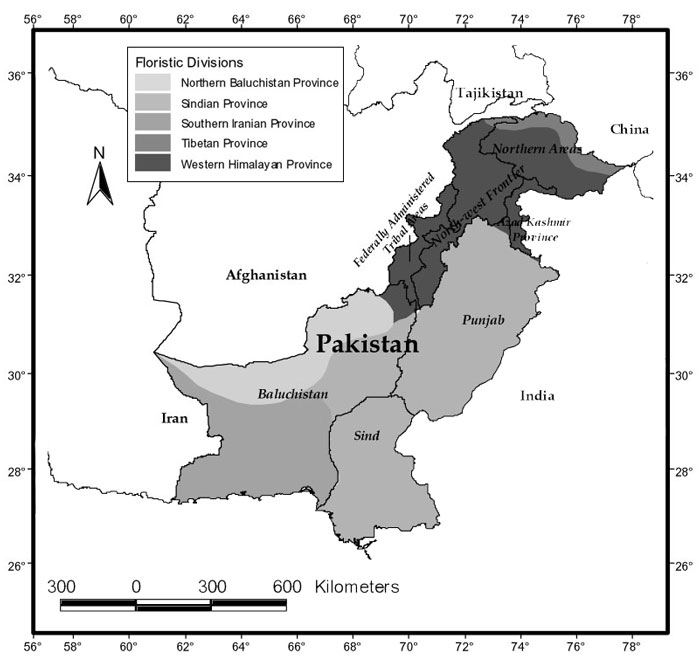
Figure 1. Map of Pakistan, showing boundaries of the four provinces (Baluchistan, Sind, Punjab, and North-West Frontier), one territory (Federally Administered Tribal Areas), and the Pakistani-administered portion of the disputed Jammu and Kashmir region (Azad Kashmir and Northern Areas). Shading indicates floristic provinces as delineated by Takhtajan (1986).
The underlying basis of this disjunction has been explored by numerous biogeographical analyses, such as those of Stewart (1972), Zohary (1973), Ali (1978), and Hedge & Wendelbo (1978). Takhtajan (1986), summarizing much of this literature, delineated five distinct floristic provinces that extend into the territory of Pakistan (Fig. 1). Two of these provinces, the Southern Iranian and Sindian Provinces, belong to the Sudano-Zambezian Region (African Subkingdom, Paleotropical Kingdom), which extends west along the southern Arabian Peninsula through the Horn of Africa to eastern tropical Africa and across to the Atlantic coast of Mauritania, Senegal, and Guinea. The other three floristic provinces in Pakistan belong to the Irano-Turanian Region (Tethyan Subkingdom, Holoarctic Kingdom): the Northern Baluchistan and Western Himalayan Provinces in the Western Asiatic Subregion, and the Tibetan Province to the Central Asiatic Subregion. Thus, the source and affinities of the plants of southern and southwestern Pakistan are with central and eastern Africa and the coastal regions along the Arabian Sea, whereas the source and affinities of the flora in northern Pakistan are with Central Asia, from Turkey in the west to the Gobi Desert in the east. In addition, eastern Pakistan has an admixture of elements from the Indomalesian Subkingdom (Paleotropical Kingdom), and in the monsoonal forests in Azad Kashmir, one finds elements of the Eastern Himalayan Province (Eastern Asiatic Region, Boreal Subkingdom, Holarctic Kingdom).
The flora of Pakistan includes no endemic families, and only three endemic genera (Douepia in Brassicaceae, Stewartiella in Apiaceae, and Decalepidanthus in Boraginaceae). In all, there are some 203 endemic species, or about 4% of the flora (Ali 1978). Many of these endemic species are found in the montane regions of northern Pakistan, particularly in the Chitral and Kashmir districts, and in northern Baluchistan. Notwithstanding, these regions are considered to be relatively poorly known and likely to be sources of new species (Chaudhri 1977, Frodin 1984).
Pakistan has a human population of some 141,500,000 (July 2000 est.), according to The World Factbook 2000 (www.odci.gov/cia/publications/factbook/geos/pk.html). Because some areas of Pakistan, especially the arid southwest (Baluchistan) and the mountainous north, are inhospitable and sparsely populated, this large population is heavily concentrated in the Indus Valley. The environmental impacts of this huge human population and the very long history of human occupation of the Indus Valley (home to a highly developed urban civilization at least 5,000 years ago) present special challenges to the government. Many of the most pressing environmental issues in Pakistan involve water, i.e., water pollution from raw sewage, industrial wastes, and agricultural runoff, and shortages of potable water for a majority of the populace. The other major environmental problems – deforestation, soil erosion, and desertification – are also closely tied to water use and availability.
---- Conservation & Environmental Issues ----
Pakistan has a human population of some 141,500,000 (July 2000 est.), according to The World Factbook 2000 (www.odci.gov/cia/publications/factbook/geos/pk.html). Because some areas of Pakistan, especially the arid southwest (Baluchistan) and the mountainous north, are inhospitable and sparsely populated, this large population is heavily concentrated in the Indus Valley. The environmental impacts of this huge human population and the very long history of human occupation of the Indus Valley (home to a highly developed urban civilization at least 5,000 years ago) present special challenges to the government. Many of the most pressing environmental issues in Pakistan involve water, i.e., water pollution from raw sewage, industrial wastes, and agricultural runoff, and shortages of potable water for a majority of the populace. The other major environmental problems – deforestation, soil erosion, and desertification – are also closely tied to water use and availability.
In order to begin to address these problems, Pakistan needs good information about its natural resources. A Flora based on all available plant collections and on the most current taxonomy and phylogeny of those plants is an essential first step to understanding, managing, and preserving the biodiversity of any area. Because terrestrial communities are generally defined by their plants, a Flora forms the foundation to which inventories of animals, fungi, etc., can be added. Completion of the Flora of Pakistan will provide scientists and government officials with critical information for management of their resources. Because the database resulting from this project will be geographical in nature, it can be used with data on soil types, precipitation, and other parameters to address questions such as what intact habitats should have highest priority for conservation, and what types of plants should be used in restorations for erosion control, reforestation, and the like.
Nasir (1991) conservatively estimated that 580-650 plant species (c. 12% of the flora) are threatened or endangered, but suggested that this number would increase when work on the Flora is completed. He cited habitat destruction, over-exploitation of economic plants, introduction of alien species, and pollution as the major causes for this threat. Nasir (1991), Sulaiman et al. (1991), and others suggest that awareness of the problems is widespread, but that additional knowledge and information is critical if the problems are to be addressed and solutions found. ---- Botanical Collecting in Pakistan ----
Stewart (1972, 1982), Hedge (1991), and others have reviewed the history of botanical exploration in Pakistan fairly extensively. Starting in 1820 with an expedition to Kashmir by William Moorcroft, many European (mainly British) botanists visited Pakistan, eventually collecting plants from virtually all parts of the country. The coverage was modest in the mountainous areas in the north, inhabited by often-hostile tribes and naturally inhospitable as the nexus of the Hindu Kush, Karakoram, and Himalayan ranges. The results of these collecting activities contributed to the two great floras of the region, the Flora Orientalis (Boissier 1867-1888) and the Flora of British India (Hooker 1872-1897). Collecting continued in the early twentieth century, rendering much of those great 19th century floras out-of-date. One important aspect about the collections made in Pakistan prior to the country's establishment in 1947 is that virtually all of them were housed either in Europe (mainly BM, E, and K) or in India, at Calcutta or Dehra Dun, in both cases inaccessible to botanists in Pakistan (Stewart, 1972). The largest plant collection in Pakistan in 1947 was that developed by Ralph Stewart at Gordon College in Rawalpindi.A comprehensive and accessible flora of this region is essential to our understanding of the plants of south Asia generally, and will be particularly useful in relation to floristic projects such as the Flora of China, the Flora Malesiana, and ongoing work in India and in the central Asian region. Many local Floras exist for parts of Pakistan (Stewart 1982), but these have been superseded by the Flora of Pakistan. The Flora of Afghanistan (Kitamura 1960) is actually a synoptical checklist in format, covering the results of expeditions to the Karakoram and Hindu Kush by Japanese botanists in 1955. A later report from the same expedition (Kitamura 1964) enumerated plants from the part of the region in Pakistan. This region where the Western Himalayas meet the Karakorams and the Hindu Kush in northern Pakistan and the northern Baluchistan region are rich in endemic plants, and many genera of agricultural and horticultural importance occur in Pakistan, yet our knowledge of them and access to information about them is limited at the present time.
---- History of the Flora of Pakistan Project ----
As the new nation of Pakistan began to develop universities and a scientific infrastructure, it became obvious that a first priority in the area of botany would be production of a Flora for the country. In 1960, Stewart retired from active work at Gordon College, and turned over his herbarium, then numbering about 50,000 specimens, to his collaborator Prof. E. Nasir. The "Stewart Herbarium" was later presented as a gift to the nation, and formed the nucleus of the National Herbarium of Pakistan (Ali & Ghaffar 1991). This collection, and those established at other institutions, particularly at the University of Karachi by S.I. Ali, provided the necessary foundation for writing the Flora. During the 1960's, the U.S. Department of Agriculture developed a scheme to use PL480 funds, which had to be spent within the country, to collect plants in Pakistan. That program ultimately did not survive, but the funds were still available and a new proposal was developed. The Flora of Pakistan project was initiated in 1968, with Nasir and Ali appointed as Joint Editors. They set to work immediately, and in 1970, the first fascicle (Flacourtiaceae) of the Flora appeared. Another of the early publications of the project was the "Annotated Catalogue of Vascular Plants of West Pakistan and Kashmir" by Stewart (1972), intended as a preliminary checklist of the plants of the region and a guide to the developing Flora project. Stewart included 5,783 species in his catalogue, and Flora treatments published subsequently have not changed that overall estimate appreciably (Ali 1991), although new treatments for individual genera/ families differ, sometimes substantially, from those by Stewart.By 1995 the Flora project had produced 197 treatments (one per family), ranging in size from a few pages to nearly 500 pages (Poaceae). Nasir (replaced by M. Qaiser after his death) and Ali or their colleagues and students wrote many of these treatments, while others have been completed by specialists worldwide working with them. Even though the herbaria within Pakistan have developed accordingly, the authors have had to consult extensively with British and other foreign herbaria since they contain large historical collections and the type specimens of most species in Pakistan. The USDA funding supported the publication of most of these treatments, but the PL480 program ultimately came to an end, and work on the remaining volumes needed to complete the Flora since 1995 has been hampered by lack of funding. The total number of species included in the 202 published treatments (see List) is about 4,200, which leaves some 1,500 species in 11 families (c. 25% of the entire flora) still to be treated.
---- The Flora of Pakistan: Current Status ----
In 1999, at the XVI International Botanical Congress, S.I. Ali (University of Karachi and principal editor of the Flora of Pakistan) proposed a plan to Peter H. Raven (Missouri Botanical Garden) for completing the Flora in five years with the Missouri Botanical Garden as co-publisher. Following negotiations, in February 2000, the University of Karachi and the Missouri Botanical Garden signed an agreement to co-publish the remaining volumes of the Flora of Pakistan over a period of five years. This initiative has several strong positive features:
---- Checklist of the Plants of Pakistan ----
The third "product" intended to derive from this project is the Checklist of the Plants of Pakistan. Just as Stewart's (1972) "Catalogue" was intended to summarize existing data and stimulate new research, so too do we intend for the Checklist to be a stimulus for future work. The format of the Checklist will be similar to that of the recent Catalogue of the Vascular Plants of Ecuador (Jørgensen & León 1999) and will present a synopsis of the entire flora of Pakistan. For each accepted name, this format will include author and citation, synonyms, abbreviated distribution statement, one verified voucher (and/or the type specimen, if from Pakistan), and references to major literature on the taxon. Introductory chapters will briefly summarize information about Pakistan's geology, paleoclimate, geography, climate, vegetation, and history of exploration. It will be based on the Pakistan Database, and will be available both electronically and as a published volume. However, all treatments will be reviewed and compared with current taxonomy and nomenclature, especially by reference to treatments in Flora Iranica, Flora of China, and recent monographs. Whenever possible, the family treatments for the Checklist will be sent to specialists for review. This type of revision will be particularly important for fascicles published early in the Flora project, and for groups in which current research is particularly active.
---- Database Development ----
The database for the Flora of Pakistan project is being developed on the same model as that for the Flora of China project (http://flora.huh.harvard.edu/china). Ali and colleagues will provide the remaining treatments (starting with Iridaceae) as Word documents, which will be parsed (paragraph-delineated) and converted into an Excel database. All earlier treatments will be scanned using an optical character reader (OCR) and saved as Word documents, edited for accuracy against the original, parsed, and converted. Each element of the Flora treatments – family descriptions, notes, and keys; generic descriptions, synonymies, notes, distribution, and keys; and species names, place of publication, types, synonymies, notes, indigenous uses, distribution, phenology, cited specimens, and illustrations – will be included in this interactive database. Ultimately, users will be able to search the database using a variety of queries. More than half of all species in the Flora of Pakistan are illustrated, and these drawings and photographs will be scanned and made available electronically.The specimens cited in the Flora of Pakistan, which include full available label data, are arranged according to a grid system (see map in DATA, which is included at the front of each volume of the FOP) rather than by province or district. Each grid unit corresponds to a "square" measuring 2° on each side. As a result, every cited specimen can be mapped to within 1° accuracy by using the central point in each grid unit, even though very few include latitude/longitude readings. So a specimen listed as "D-5" (corresponding to 30°-32° N/68°-70°E) can be mapped to 31°N/69°E. Eventually we intend to have coordinates for all localities in Pakistan, but until that system is in place, we already have a geographical basis for the database. The main database will be housed at the Missouri Botanical Garden as it is being constructed, and the web site will reside on a Garden server, at least initially. As soon as the University of Karachi has the capability to host the site, a mirror site will be installed there, making the information much more readily available in Pakistan and the surrounding region.
Many results of the proposed project will have a direct and beneficial impact on conservation efforts in Pakistan. Knowing what species occur where, at what elevations, with what other species, and whether the species is rare, is the type of information that is critical for informing decisions about where to establish conservation areas, how big to make them, etc. The ability to combine data on known collections, soil types, elevations, associated plants, and other parameters will make it possible to identify areas of potential distribution of rare species, or to select appropriate plants to be used in ecological restorations. In a country with limited resources suffering serious problems of deforestation, soil erosion, and desertification (Nasir 1991), the ability to make rapid, fully informed decisions regarding restoration and other conservation projects is extremely important, and depends on sufficient background data.
Stewart (1972, 1982), Hedge (1991), and others have reviewed the history of botanical exploration in Pakistan fairly extensively. Starting in 1820 with an expedition to Kashmir by William Moorcroft, many European (mainly British) botanists visited Pakistan, eventually collecting plants from virtually all parts of the country. The coverage was modest in the mountainous areas in the north, inhabited by often-hostile tribes and naturally inhospitable as the nexus of the Hindu Kush, Karakoram, and Himalayan ranges. The results of these collecting activities contributed to the two great floras of the region, the Flora Orientalis (Boissier 1867-1888) and the Flora of British India (Hooker 1872-1897). Collecting continued in the early twentieth century, rendering much of those great 19th century floras out-of-date. One important aspect about the collections made in Pakistan prior to the country's establishment in 1947 is that virtually all of them were housed either in Europe (mainly BM, E, and K) or in India, at Calcutta or Dehra Dun, in both cases inaccessible to botanists in Pakistan (Stewart, 1972). The largest plant collection in Pakistan in 1947 was that developed by Ralph Stewart at Gordon College in Rawalpindi.
As the new nation of Pakistan began to develop universities and a scientific infrastructure, it became obvious that a first priority in the area of botany would be production of a Flora for the country. In 1960, Stewart retired from active work at Gordon College, and turned over his herbarium, then numbering about 50,000 specimens, to his collaborator Prof. E. Nasir. The "Stewart Herbarium" was later presented as a gift to the nation, and formed the nucleus of the National Herbarium of Pakistan (Ali & Ghaffar 1991). This collection, and those established at other institutions, particularly at the University of Karachi by S.I. Ali, provided the necessary foundation for writing the Flora. During the 1960's, the U.S. Department of Agriculture developed a scheme to use PL480 funds, which had to be spent within the country, to collect plants in Pakistan. That program ultimately did not survive, but the funds were still available and a new proposal was developed. The Flora of Pakistan project was initiated in 1968, with Nasir and Ali appointed as Joint Editors. They set to work immediately, and in 1970, the first fascicle (Flacourtiaceae) of the Flora appeared. Another of the early publications of the project was the "Annotated Catalogue of Vascular Plants of West Pakistan and Kashmir" by Stewart (1972), intended as a preliminary checklist of the plants of the region and a guide to the developing Flora project. Stewart included 5,783 species in his catalogue, and Flora treatments published subsequently have not changed that overall estimate appreciably (Ali 1991), although new treatments for individual genera/ families differ, sometimes substantially, from those by Stewart.
In 1999, at the XVI International Botanical Congress, S.I. Ali (University of Karachi and principal editor of the Flora of Pakistan) proposed a plan to Peter H. Raven (Missouri Botanical Garden) for completing the Flora in five years with the Missouri Botanical Garden as co-publisher. Following negotiations, in February 2000, the University of Karachi and the Missouri Botanical Garden signed an agreement to co-publish the remaining volumes of the Flora of Pakistan over a period of five years. This initiative has several strong positive features:
- It will complete a Flora of an important and insufficiently known region;
- It connects geographically and floristically with the Flora of China project headquartered at the Garden (many taxa in common, often requiring a coordinated approach);
- It provides the best opportunity to develop a database of plants for south Asia, which can connect with comparable databases for China and elsewhere and can serve Pakistan as an important biodiversity management tool; and
- It will provide a source of new collections from that region, which is poorly represented in American herbaria.
The third "product" intended to derive from this project is the Checklist of the Plants of Pakistan. Just as Stewart's (1972) "Catalogue" was intended to summarize existing data and stimulate new research, so too do we intend for the Checklist to be a stimulus for future work. The format of the Checklist will be similar to that of the recent Catalogue of the Vascular Plants of Ecuador (Jørgensen & León 1999) and will present a synopsis of the entire flora of Pakistan. For each accepted name, this format will include author and citation, synonyms, abbreviated distribution statement, one verified voucher (and/or the type specimen, if from Pakistan), and references to major literature on the taxon. Introductory chapters will briefly summarize information about Pakistan's geology, paleoclimate, geography, climate, vegetation, and history of exploration. It will be based on the Pakistan Database, and will be available both electronically and as a published volume. However, all treatments will be reviewed and compared with current taxonomy and nomenclature, especially by reference to treatments in Flora Iranica, Flora of China, and recent monographs. Whenever possible, the family treatments for the Checklist will be sent to specialists for review. This type of revision will be particularly important for fascicles published early in the Flora project, and for groups in which current research is particularly active.
The database for the Flora of Pakistan project is being developed on the same model as that for the Flora of China project (http://flora.huh.harvard.edu/china). Ali and colleagues will provide the remaining treatments (starting with Iridaceae) as Word documents, which will be parsed (paragraph-delineated) and converted into an Excel database. All earlier treatments will be scanned using an optical character reader (OCR) and saved as Word documents, edited for accuracy against the original, parsed, and converted. Each element of the Flora treatments – family descriptions, notes, and keys; generic descriptions, synonymies, notes, distribution, and keys; and species names, place of publication, types, synonymies, notes, indigenous uses, distribution, phenology, cited specimens, and illustrations – will be included in this interactive database. Ultimately, users will be able to search the database using a variety of queries. More than half of all species in the Flora of Pakistan are illustrated, and these drawings and photographs will be scanned and made available electronically.