Goat Breeding Tips for Livestock Farmers (Urdu)

In order to get maximum meat and milk Beetal, Daira Deen Panah, Nachi, and Teddy Breeds.....

Mango Amazing Facts

The mango is known as the 'king of fruit' throughout the world. The name 'mango' is derived from the Tamil word 'mangkay' or 'man-gay'. When the Portuguese traders settled in Western India they adopted the name as 'manga'.

Pomegranate(Punica granatum) Cultivation and Farming

Pomegranates are fairly drought tolerant and can be grown on either calcareous or acid soils. Climate - Grow best in dry climates with mild winters. Chilling requirement

EU may also ban Monsanto GMO in wake of shocking cancer findings

Russia's consumer protection group, Rospotrebnadzor, said it was halting all imports of GM corn while the country's Institute of Nutrition will be evaluating the results of the study.

Protect Garden Pots during Winter

Many pots, especially ornamental containers that aren’t designed to stand outside in freezing temperatures, need winter protection. Wrap them up in burlap (possibly double layers), and secure tightly at the top and bottom with strong garden string.

Sustainable Agriculture and Fertilizers Practices in Pakistan

Agriculture is the mainstay of Pakistan’s economy. It has a total area of 79.61 million hectare, and the total area used for crop production is only 22 million ha.

Herbs For Winter Windowsill

Growing season is over, do you still find yourself ready to dash out to the garden for some chives, basil or a sprig of thyme...

Claim FREE EBook

Once you subscribe you will get a confirmation email from agrinfobank about joining the mailing list.

Showing posts with label Home gardening. Show all posts

Thursday, 27 December 2012

Garden Talk: A New Leaf in Your Home Garden

By Zahrah Nasir
Q: I recently relocated to Islamabad from Karachi and wish to grow vegetables in my garden. Is this the right time? If so, please recommend three or four easy to grow ones and how to go about their cultivation.
A: Yes this is the perfect time to put in some vegetable seeds. At this time of the year it is best to grow your vegetables in a sunny position. You could start out with peas, carrots, spinach and lettuce which are all reasonably simple to grow. Peas, spinach and lettuce all do well in soil that has had lots of old, well-rotted, organic manure worked into it, whilst lettuce requires the same but with some river sand added to ensure good drainage.

Picture Source: Google
Peas should be sown half an inch deep and an inch apart to obtain strong plants and they will need supports, such as trellis-work or canes to climb up. Spinach and lettuce seeds should be sown, very thinly, about quarter of an inch deep, in rows four to five inches apart and lettuce seeds, these are very fine, thinly just under the soil surface, in rows six to 10 inches apart. Carrot seed, once again the seed is very small, is best sown thinly, just under the soil surface, in rows no more than six inches apart. All should be kept weed-free and watered regularly.
Q: I would appreciate your comments on my quick organic fertiliser recipe: One cup mustard/cotton oil cake powder. Half cup dry alfa powder. Half cup wood and paper ash. Half cup wood powder. Four or five powdered egg shells. Three to four rusty iron nails. Use 50/50 with soil.
A: Firstly I do not personally recommend the use of either mustard or cotton oil seed cake in the garden. Much better to use ‘bagass’ which is residual organic material from sugar mills. I am puzzled by ‘alfa powder’ unless you mean dried, ground up alfalfa which is fine. The wood/paper ash is good, as are the powdered egg shells; iron nails are good too if they are small ones and if you take care to bury them deeply in order to avoid accidents.
By ‘wood powder’, I presume that you mean sawdust. Fresh sawdust heats up as it rots down and will burn your plants and their tender roots. It should first be composted down and, only then used in the garden. It would be interesting to know how your plants have reacted to your fertiliser as detailed. Experimentation is great, please keep it up and growing organic is the best way to proceed.
Q: I have been nurturing an ivy creeper which finally developed roots and climbed the criss-cross wooden frame alongside my bay window. Over a period of five years the plant covered the whole structure and looked beautiful. Unfortunately, all of a sudden the leaves started yellowing and falling, leaving a large area bare. I thought that the tube well water — laboratory analysis says it is unfit for human consumption — could be the cause so I switched to normal sweet water praying that would help. The plant does appear to be developing new leaf buds but I am really worried about what to do.
A: Your ivy sounds gorgeous and you are commended for getting it to do so well. It is good that you stopped giving your ivy the tube well water as it sounds as if this was the problem.
The fact that, after switching over to sweet water, the ivy shows signs of growth is very encouraging and I think that patience should be exercised now. The plant should re-grow in time.
Q: I have a problem with my fig tree in Islamabad. The leaves are yellowing and falling. What should I do?
A: This tends to happen during periods of high summer humidity or rain and is absolutely nothing to worry about at all.
Q: I am trying to grow bananas and pomegranates but neither bear fruit. The leaves of both get so badly damaged by strong winds that they die. I recently added organic fertiliser to the soil and I water regularly. How can I improve their condition please?
A: Cultivating bananas and pomegranates in a windswept location is asking for trouble. The only solution to the problem is to erect wind protection, the type depending on the size of your garden.
Q: Is avocado a remedy for arthritis? Is it possible to purchase the plants in Karachi or do I need to look elsewhere?
A: Eating avocadoes will not cure arthritis but a poultice made from the bark and leaves is, it has been claimed, helpful in the treatment of rheumatism. I do not know if avocado saplings are now stocked in Karachi nurseries but I doubt it. Avocadoes grow into huge trees and both male and female are required for them to fruit. The climate of Karachi is not really suitable for their cultivation.
Source: The Dawn, InpaperMagzine
Published on: 10/15/2012

Wednesday, 26 December 2012

How To Grow Ginger At Home

When I started growing ginger root I expected it to be difficult. It's not.
Growing GingerI've been growing ginger at home for years, and ginger would have to be a serious contender for the title "most neglected plant" in my garden.
(Which is a shame. Ginger is a beautiful and beautifully scented plant. I really should move it. One day...)
I look at my ginger plants exactly once a year, at harvest time. I harvest them, replant them, and then forget about them for another year.

I easily grow a year's supply of ginger root from them. I also have plenty left over to give away, both ginger root planting material and ginger for eating.
You can get started using store bought ginger root. And you can easily grow ginger in pots or tubs, so growing ginger indoors is a possibility in cooler climates.
On this page I tell you everything you need to know about growing ginger, so you can grow your own fresh ginger, too.

Growing Ginger Root Is Not That Hard...

...provided you get a few basics right. Let's first look at some pictures of ginger plants and the roots:
Foliage of ginger plants.A ginger rhizome with roots.
The picture on the left shows the foliage of ginger plants. On the right you see a rhizome.
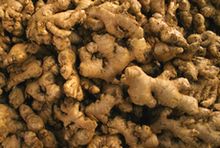
To talk about ginger root when talking about the edible part of the ginger plant is actually incorrect. You eat the rhizomes, and as you can see, rhizomes have roots... Two different things...
But I'll keep talking about ginger root anyway, that's what everybody does and you know what I mean.

What ginger plants like and dislike:

Ginger loves a sheltered spot, filtered sunlight, warm weather, humidity, and rich, moist soil. (What else did you expect from a tropical plant?)
What ginger can't stand is frost, direct sun, strong winds, and soggy, waterlogged soil.

Planting Ginger Root

The easiest way to get started growing ginger root is to get a few fresh rhizomes of someone who does grow ginger, at the time when the plant re-shoots anyway (early spring). Otherwise just buy some at the shops at that time.
Ginger root with growth buds.
Make sure you select fresh, plump rhizomes.
Look for pieces with well developed "eyes" or growth buds. (The buds look like little horns at the end of a piece or "finger")
Some people recommend to soak the rhizomes in water over night. That's not a bad idea, since shop bought ginger might have been treated with a growth retardant.
I also read the advice to sit rhizomes in water until they sprout roots. That's nonsense. Your ginger plant will be much happier if the roots are in the ground and can breathe right from the start, rather than having to deal with the transplanting shock and the change in conditions. If the ground is moist and warm they will root very easily.
Whether you grow your ginger root in a pot or in the ground, you do need really good soil to start with. It needs to be rich enough to feed your ginger (you can always add some fertiliser, see below), it needs to hold enough moisture so it doesn't dry out, but it needs to be free draining so the ginger roots don't become water logged.
Good compost is of course ideal. I use a mix of one part of my best compost with one part of my sandy garden soil. The compost supplies the nutrition and holds water, and the sand/loam makes sure the mix drains freely.
If your garden has reasonable soil just dig in some compost and that should be good enough. If your soil is too heavy you can make a raised bed or a small hill or ridge to improve drainage.
The best planting time is late winter/early spring (late dry season/early wet season, in the true tropics). Make sure you select a spot where the plants get plenty of light but no direct sun, and where they are protected from wind.
You can cut or break up the ginger rhizomes in little pieces with a couple of growing buds each. Or just plant the whole thing. Plant your ginger root five to ten centimetres deep, with the growing buds facing up.

How much space?

Growing ginger doesn't take up much room at all. Every rhizome you plant will first only grow a few leaves, in the one spot. Over time it will become a dense clump and very slowly get bigger, but only if it isn't harvested.
The rhizomes underground also don't seem to mind if they become a bit crowded.
Ginger only grows to about two to three feet in height.
A 14 inch pot easily holds three average rhizomes, a rectangular styrofoam box holds about nine to a dozen. If planting them in the ground plant them about six to eight inches apart. And if you want to plant a whole hectare order 1000 - 1500 kg :-).

How much water?

Ginger needs a lot of moisture while actively growing. The soil should never dry out. Don't overwater, though, because the water that drains away will take nutrients with it.
Ginger loves humidity. If you have problems with dry air then regular spraying and misting might help. Dry air can cause problems with spider mites. But that's rather a problem for people who try to grow ginger out of its range and indoors. A sheltered, moist spot in a warm climate will provide enough humidity.
Mulched, young ginger plant
If you are growing ginger in the ground mulch it thickly.
It helps to keep the ground moist, it helps feed the ginger as the mulch breaks down, and it also keeps down weeds.
(Ginger is a slow growing plant and easily overgrown by others.)
Towards the end of summer, as the weather starts cooling down, your ginger will start to die back. Reduce the water, even let the ground dry out. This encourages the ginger to form rhizomes. Once all the leaves have died down your ginger is ready for harvest.

How much and which plant food?

If you are growing ginger in good, rich soil it shouldn't need anything extra. I grow mine in tubs. I put in fresh compost mix every year and never add any extra fertiliser.
If you don't have good soil, or if you are growing ginger in some standard bought potting mix, then you have to feed it regularly. You will also have to feed it if you are growing ginger in an area that gets torrential summer rains (many tropical regions do). Such rains leach all the goodness from the soil.
Work in some organic slow release fertiliser at planting time. After that you can use some liquid fertiliser like seaweed extract or fish fertiliser every few weeks.

When to harvest ginger root?

If you are growing ginger root in the garden you can start stealing little bits of it once it is about four months old. Just dig carefully at the side of a clump. (This "green ginger" does have a lot less flavour than the mature stuff, though.)
The best time to harvest ginger is any time after the leaves have died down. Usually it takes eight to ten months to get to that point.
Ginger growing in styrofoam boxes
You can now dig up the whole plant. The reason that I grow my ginger in tubs is that it makes the harvest so easy. I don't have to dig, I just tip out the whole thing.
Break up the rhizomes, select a few nice ones with good growing buds for replanting (you can replant them straight away), and keep the rest for the kitchen. (I simply peel, chop and freeze the whole lot. An even better way is to cut it into small chunks and store it in brandy. Brandied ginger keeps like fresh. Thank you to reader Jan Stevenson for this tip.)
The rhizomes that have been replanted or left in the ground don't need any water or attention until the weather warms up again. Mine still get watered where they are, and that doesn't seem to hurt them either.
The other way to grow and harvest ginger is to have many clumps growing around your place, and to just dig up what you need, when you need it. The plants grow outwards from the mature rhizomes. Once a clump is big enough you can harvest the mature tubers without damaging new shoots.
By the way, if you are serious about growing ginger at home then resist the urge to harvest it for a year or two. Rather build up a good resource stock first. I started with one little rhizome and dug it up the first time after two years. I replanted every single promising looking bud and still had some to eat. Next year I did the same, and after that I harvested enough to last me a year.

When does ginger flower?

When growing ginger as outlined above you won't see any flowers. A clump needs to be about two years old to flower. So if you want to see your ginger flower leave it in the ground, and just dig very carefully at the edges of it to harvest bits here and there.
The flowers of culinary ginger are green and insignificant anyway.
Ginger FlowerFlowering ginger plants.
There are however some spectacular flowering gingers. If you are after great flowers get some of those. They are grown exactly like the culinary ginger, just skip the harvest :-).
There's also a pretty variegated ginger, with white and green striped leaves. All the ornamental varieties are evergreen in the tropics (meaning they don't die down like the culinary ginger).

A few final notes for people in cool climates:

Don't expect to be harvesting much of your ginger plants. You'll be growing ginger mostly as an ornamental plant. It is a really pretty plant with its glossy strap leaves, and it smells beautifully when you brush against it.
Start your ginger indoors, it will be too cold outside in spring. Don't worry about the dappled sunlight. In your parts of the world the sun isn't as intense. Your ginger should be able to handle it and it needs all the warmth it can get.
You may or may not be able to keep it alive over winter, depending on where you are. Definitely move it inside at the first signs of cold weather. Once the leaves die back keep it reasonably dry and cool or the tubers will rot, and with a bit of luck your ginger may grow back next year.

Garden Talk: Time To Grow Green and Purple

By Zahrah Nasir
Q: I am planning to cultivate quite a lot of basil and would be grateful if you can guide me through the basics. How to sow the seed, soil conditions, fertiliser, watering and where to get good quality seed.
A: Basil, there are many varieties with different coloured/shaped leaves and different flavours, is very simple to grow from seed. The seedlings do not like being disturbed as they have a long tap root which is easily damaged so it is best to sow them very thinly and according to species, as some are larger than others, where they are to grow.

Garden Talk: Time To Grow Green and Purple

Soil that is rich in organic material is ideal. Basil flourishes in full sun and while it requires regular watering, good drainage is essential. The seed needs warmth to germinate so is best sown in spring when temperatures are on the rise although it can also be started off in autumn before temperatures drop and then grown under plastic/glass for the winter.
Once you have some mature plants, these can also be increased by propagating from cuttings. Basil should not require additional fertiliser if the soil is correctly prepared prior to sowing the seed. Nip out the central growing shoots when the plants are four to six inches high, this encourages them to bush out and produce more of their deliciously aromatic leaves. Keeping the strongest plants for seed production is always, as long as the seed was not hybrid, a good idea. You need to shop around for seed and perhaps, especially if opting for an ‘unusual’ variety, import it yourself.
Q: Is there any species of perennial viola, a fragrant one, which can be grown in Lahore?

A: I am delighted to say that there is! Viola odorata is the answer. Grow it in partial shade, keep watered and you will be magnificently rewarded.
Q: For the past few years I am unable to make my Nerine bowdenii flower. I am growing it in medium-size plastic pots. It does grow leaves but does not go dormant at all. I think that it should go dormant before the monsoon and then flower in August/September. Any tips?

A: The plant needs to have a rest in order to build up enough energy to flower: Going on and on producing leaves uses all its strength up. I would suggest giving it a hand by withholding water for at least six weeks before the arrival of the monsoon and then let nature take over.
Q: I’m into growing flowers at my place outside Lahore. I want to grow something which is not a run-of-the-mill commodity. Any ideas?

A: If these are to be used as cut flowers then I suggest the following: Venidium, platycodon, rudbeckia, inula, ismelia, bracteantha and please don’t overlook dahlias as there are literally hundreds of beautiful varieties and they all, especially the long-stemmed ones, make excellent cut flowers.
Q: I am planning on growing some tall trees around my house in Quetta and am thinking of coconuts or some other type of palm. Kindly tell me if I can do this and, if so, then what it is the best time to plant them. If this is not possible then please suggest a suitable species.
A: Coconuts are not suitable for Quetta and, aside from date palms, I strongly suggest that you avoid any kind of palm at all as they are liable to suffer frost damage in the winter. I realise that you want something tall and graceful but it really makes more sense, given the prevailing economic conditions, to grow something productive like a selection of fruit trees to give you fresh produce over as long a period as possible.

Q: Can blue hibiscus be grown successfully in Lahore — I haven’t seen them here. There are two most common species with blue flowers Alyogyne huegelli and Hibiscus syriacus. Can these be grown in Lahore from seed and do they require the same care as wild hibiscus?
A: I suspect that you mean Hibiscus huegelli not Alyogyne. H. huegelli, the Australian satin hibiscus with gorgeous lavender coloured flowers and Hibiscus syriacus should both be fine as long as good growing conditions are provided. They are very different in their requirements to wild hibiscus. Give them well drained, sandy soil with lots of humus worked in and grow in full sun. Take care that the seedlings do not damp off.
Picture source: Google.

Source: The Dawn, InpaperMagzine
Published on: 10/25/2012

Garden Talk: Planting Ideas

By Zahrah Nasir
Q: I have an area of land close to Bahawalpur and want to develop it for personal agricultural use. Please give me some advice as to what I should grow there. I would ideally prefer a mix of edible and ornamental species of plants.
A: Depending on the area of land concerned I would suggest that you put part of it down to grain, part to vegetables and herbs and a smaller section to whatever ornamentals you desire although, frankly speaking, I would give the latter a miss. Dividing the area up with rows of fruit trees would help maximise land use and provide shade for seasonal crops during the blazing summer heat in your locality. As long as water isn’t an issue and soil salinity is minimal you have lots of choice.

Garden Talk: Planting Ideas

Q: You once suggested that garlic vine is very adaptable to the climates of Karachi and Lahore but I have tried with two plants, from different nurseries in Lahore, and they are not performing well. There are no signs of pests or disease but the plants do not put on new growth. I tried directly in the soil and in a pot. I changed the soil and added fertiliser but still the plants do not grow. Are you sure that garlic vine grows in Lahore and, if so, what could possibly be wrong?

A: Garlic vines grow wonderfully in Lahore! From what you say though I suspect that you are disturbing yours before they have a chance to spread out their root systems and take off. Moving plants around gives them a ‘check’ and they suffer badly from this as, each time they are disturbed, the root system suffers. Just leave them be, let nature take its course and if they survive the trauma they have already suffered, they will reward you in time.
Q: I am interested in growing ‘Abronia’ (sand verbena) in Lahore for its fragrant flowers. Should it be grown in sandy soil? Will it be perennial and is it suitable for here?

A: Abronia should do well in Lahore and will be perennial providing that correct growing conditions are maintained. This species needs almost pure sand with excellent drainage. Seedlings and young plants will need a little water from time to time but mature plants do not. The only potential problem is during the summer monsoon when, if at all possible, the plants should be protected from the rain and associated high humidity. You could perhaps erect some form of temporary shelter over them during this period.
Q: Are there any shrubs which flower before they come into leaf that are suitable for cultivation in Lahore? I know of two members of the ‘Prunus’ family that do this but they are not easy to grow here.
A: Yes. Forsythia, with its glorious golden flowers in very early spring, will meet your needs.
Q: I grew some gorgeous geraniums from seed this year and they are in full bloom. I have them in pots on a sunny veranda in Islamabad and they are in perfect health. What I need to know is: Do I have to bring them indoors for the winter or will they be okay where they are.

A: Geraniums are more cold tolerant than people tend to think. They should be absolutely fine in your veranda as long as it isn’t exposed to cold winds. If you are very concerned, and I can understand if you are, then take them indoors and place them where they get plenty of natural light and put them back outside in early spring.
Q: Can climbers from the ‘Asarina’ family, such as ‘Maurandia’ and ‘Asarina’ be grown in Lahore and, if so, in which month should the seeds be sown?
A: Asarina itself is fine but Maurandia may be a little more problematic. Both should be sown during early spring as soon as the temperature begins to rise but, even then, starting them off under glass or at least covering them at night is recommended.
Q: Which varieties of ‘Lillium’ are suitable for hot climates like Lahore? I am not happy with either Oriental or Asiatic lilies. I would also prefer a variety which can be kept in the soil all summer instead of having to be dug up and stored.

A: Oriental and Asiatic lilies are about the best bet in Lahore and neither of them should be dug up and stored at any point in the year. As long as drainage is good, the bulbs will rot otherwise, they should thrive and multiply if left in the ground. Putting them into storage is unnatural and breaks their natural growing cycle.
Q: I want to cultivate mushrooms in a pot in my house in Lahore. Where can I get spawn and other related material?
A: I suggest that you contact the Horticultural Department of Faisalabad Agricultural University for full growing instructions, advice and for spawn. You should find a contact via an internet search.
Picture source: Google.
Source: The Dawn, InpaperMagzine
Published on: 12/09/2012

Why Bamboo should not be planted in your home

Bamboo is a trendy star of the eco-friendly construction movement, with a wide variety of flooring, furniture and other items being manufactured with the strong, fast-growing grass. However, bamboo production should be left to commercial growers. Bamboo’s hardiness and rapid growth make it a problematic plant for most yards. Here are the top five reasons not to plant bamboo in your garden.
1. Bamboo can spread into neighboring yards.
Many homeowners plant bamboo to create a fast-growing privacy screen around their home. Ted Jordan Meredith, author of "Bamboo for Gardens," notes that some bamboo species can grow more than three feet per day. Bamboo can spread as quickly as it grows, and it doesn’t respect fences or property lines.

Why Bamboo should not be planted in your home


Bamboo grows particularly vigorously when adjacent to irrigated lawns and gardens or in low-lying areas that collect water. Instead of just blocking the view of nosy neighbors, you could be turning your property line into a war zone by planting bamboo.
Some bamboo species may even be categorized as noxious weeds, meaning a neighbor could legally force you to remove your bamboo. You could also be liable for the cost of any damage to the neighbors’ property caused by your bamboo, and for the cost of removal from their property.
2. Bamboo can be an invasive threat to biodiversity.
Bamboo that spreads and escapes your yard can also cause ecological problems. Many spreading bamboo species are categorized as invasive exotic plants that crowd out native plants and threaten biodiversity.
The best ways to contain spreading bamboo can be expensive and complicated, and may not be worth pursuing for many homeowners. Moreover, they are not foolproof. Experts at the University of Georgia Cooperative Extension office recommend burying thick 60-ml polypropylene or fiberglass about three feet deep, and leaving another two inches of material above the soil to inhibit surface spreading. Morgan Judy of Clemson University Cooperative Extension suggests creating a solid barrier made of concrete, metal or pressure-treated wood at least 18 inches deep around the bamboo.
Any of these barriers should stop shallow bamboo rhizomes from spreading, but Judy still recommends closely monitoring the area for escaping shoots, particularly during the early summer peak growing season.
3. Getting rid of bamboo can take years.
Bamboo is a long-term relationship that should not be entered lightly. It may take years and vigorous effort to remove unwanted bamboo. The first step in removing bamboo is to remove all the root mass and rhizomes. This is easier said than done, and many homeowners with bamboo-loving neighbors complain they can’t get rid of the spreading grass. No matter how much they dig, the shoots keep coming back.
Judy suggests frequent mowing can deplete and starve the bamboo, but it take at least two years of regular mowing to see any results.
4. Getting rid of bamboo may require herbicides.
Moreover, Judy notes that chemical herbicides are often necessary for controlling bamboo. This can be a problem for those trying to maintain organic gardens and avoid herbicide use.
She recommends Roundup Original, Quick Kill Grass and Weed Killer and other herbicides containing glyphosate. This broad-spectrum herbicide has minimal residual soil activity and typically only kills the plants that are directly sprayed. Mow or chop the bamboo and let it regrow until new leaves expand. Then spray the herbicide on the leaves.
Again, this could take years. One application will not solve your bamboo problem. Also, Judy warns that only specialized glyphosate herbicides should be used near creeks, ponds and other surface water. Eraser AQ, Pondmaster and other products are approved for use near water.
5. The right bamboo can be hard to find.
Bamboo’s defenders will argue that not all of the more than 1,000 bamboo species are equally invasive. They recommend clumping bamboo species rather than spreading types. The problem is that even clumping species spread, albeit not as vigorously. It also can be hard to differentiate between the types, and some are mislabeled. Moreover, other similar invasive species may be confused with bamboo. For example, University of Arizona Cooperative Extension officials warn against transplanting or encouraging the giant reed (Arundo donax), a bamboo look-alike that has invaded parts of their state.
Bamboo may seem like an attractive garden option, but it poses serious problems. Stick to a lucky bamboo in a small indoor pot, or avoid growing bamboo altogether. Moreover, do your homework before buying bamboo flooring and other products. It may not be as eco-friendly or durable as you think.
Source: MNN
Published on: 07/17/2011

About us