
.jpg)


.jpg)
By Dr. R. D. Khuhro, Dr. S. M. Nizamani, M. M. Jiskani and M. A. Talpur
Faculty of Crop Protection, Sindh Agriculture University Tandojam
Mango, Mangifera indica is one of the important fruits of Pakistan which is exported to many countries such as Dubai, Saudi Arabia, UK, Germany, France, Holland, Switzerland, Italy, Singapore and Malaysia. It is known as “King of Fruits” and is consumed both by poor and rich people in various forms.
 Mango is grown is tropical and sub-tropical countries of the world. In Pakistan, it is grown on large acreages of Sindh and Punjab provinces. There are numerous varieties of mango, each differing in fruit characters such as taste, flavour, colour, tinge, shape and size which determine the quality of the fruits and market value at home and abroad (Jiskani, 2002).
Mango tree plant suffers from various insect pests and diseases. Among insects, mango hoppers, fruit flies, thrips, scales, stem borers, shoot borers and mites are reported (Talpur and Khuhro, 2003; Soomro, 1988). Similarly, various diseases caused by fungi such as Fusarium, Aspergillus, Botryodiplodia, Penicillium and Colletotrichum are also reported on mango (Hafiz, 1986; Ramos et al., 1991 and 1997; Wagan et al., 200; Al-Adawi, 2005). During 2002-3 in Pakistan and Sindh, the mango was grown over an area of 102.8 and 46.5 thousand hectares and the production was 1034.6 and 335.9 thousand tones per hectare, respectively (Agha, 2004). Currently, mango trees are dying suddenly at the rate of 2-20%, depending upon severity of disease and management by the owners of mango orchards.
Causes
Asian ambrosia beetle (ABB) is considered as the primary cause of the mango mortality followed by different species of fungi. Basically, this is a management problem. The owners of mango gardens give their gardens on contract and forget about care of the garden whereas, contractors don’t apply proper fertilizer, cultural and plant protection practices as per requirement of the gardens. In this way, the problem of mortality in mango is multiplying. If this, scenario remain constant, we shall end up with mango cultivation and loose export exchange in next few years. The mango growers are warned to expend at least 10% of their income on management operations for the sustainability of mango fruit in their own interest and country at large; therefore, garden owners must not depend on contractors.
Characteristics of AAB
 The Asian ambrosia beetle (ABB) has stout dark reddish-brown body and is reported as pest on broad host range including woody ornamentals, fruit and nut trees (Atkinson et al., 1988; Kovach, 1986). Schedl (1962) reported 124 hosts of ABB. The beetle has been collected and identified from various samples taken from dead or partially dead mango trees, Shisham, Gold Mohar, Gular, Neem, Eucalyptus, Siris Albizzia lebbek, rubber plant and Casia fistula from various ecological zones of Sindh. Only females have wings and disperse with small movement from infested and dead mango trees, wood logs/pieces and by its own short movements. These beetles are so tiny that initially attacked trees, don’t show symptoms.
  In case of severe infestation, the small pin head sized holes appear with the inside and outside movement of beetle on bark. The beetles excavate galleries in the branches, trunks, roots and twigs. The beetles introduce fungi complex in the mango tree and lay their eggs in clusters. In some mango trees no holes in bark appear but black spots on the basal parts of trunks are present. After cutting those barks, the light yellow paste with bad odour watery secretion flows. The beetles are also present in infested black basal part of the trunk.
  The gum like secretion/drops commonly known as gummosis oozes out from holes of trunks/branches of mango trees infested with beetle. The “C” shaped, legless, white grubs of beetle are found feeding on inner darkened portion of barks. From the infested trunk of the mango tree, the frass of the beetle is pushed out of galleries, in a typical tooth-pick fashion.
Management:
A. Asian ambrosia beetle monitoring device
· Various research experiments have been conducted and are in progress at Sindh Agriculture University, Tandojam under Mango Research Project sponsored by Higher Education Commission, Islamabad. On the basis of these preliminary experimental results, it is suggested that apply sticky traps of 1sq.ft. size by pasting grease on plastic sheets (coated over cloth) at the rate of 10-15 traps per acre at the height of 1-3 ft from ground level for catching the winged female beetles. It was also observed that green colour sticky trap attracted more female beetles followed by black and other colours.
B. Cultural
· Regular monitoring of mango gardens for bark beetle and development of decline symptoms is compulsory.
· Prune diseased branches along with 4-5 inches of healthy portion with saw and apply bordeaux paste at the rate of 1:1:10 (1kg CuSO4+1kg lime+10 liters of water)on the cut points in July-August.
· Removal and burning of diseased/dead mango trees including roots.
· Avoid wounding the trunks and roots during pruning, inter-culturing and fruit picking. In case of wounds, Bordeaux paste may be applied.
· Plowing/inter-culturing and other sanitation practices followed by pruning of gardens in July-August.
· Soil testing is compulsory for application of proper chemical fertilizers. Zinc sulphate and other macro and micro nutrients may be incorporated on the basis of soil testing.
· Proper irrigation application as and when required but not on the basis of availability of water.
C. Chemical
· Apply Lorsban 40 EC or any other systemic insecticide in combination with Alliete fungicide just after fruit setting.
· The same spray may be repeated at the interval of 15-21 days.
· Apply 3rd spray in September/October.
Method of application
· Generally foliar pesticide is carried out but in this case washing of trunks and branches through spraying or similar to white wash is suggested.
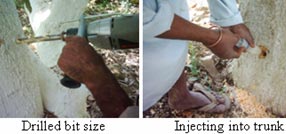
The same pesticides can also be applied by drilling followed by injecting in main trunk and its primary branches deep up to 6".Sorce: http://www.pakissan.com/english/advisory/aab.monitoringm.device.shtml


