Goat Breeding Tips for Livestock Farmers (Urdu)

In order to get maximum meat and milk Beetal, Daira Deen Panah, Nachi, and Teddy Breeds.....

Mango Amazing Facts

The mango is known as the 'king of fruit' throughout the world. The name 'mango' is derived from the Tamil word 'mangkay' or 'man-gay'. When the Portuguese traders settled in Western India they adopted the name as 'manga'.

Pomegranate(Punica granatum) Cultivation and Farming

Pomegranates are fairly drought tolerant and can be grown on either calcareous or acid soils. Climate - Grow best in dry climates with mild winters. Chilling requirement

EU may also ban Monsanto GMO in wake of shocking cancer findings

Russia's consumer protection group, Rospotrebnadzor, said it was halting all imports of GM corn while the country's Institute of Nutrition will be evaluating the results of the study.

Protect Garden Pots during Winter

Many pots, especially ornamental containers that aren’t designed to stand outside in freezing temperatures, need winter protection. Wrap them up in burlap (possibly double layers), and secure tightly at the top and bottom with strong garden string.

Sustainable Agriculture and Fertilizers Practices in Pakistan

Agriculture is the mainstay of Pakistan’s economy. It has a total area of 79.61 million hectare, and the total area used for crop production is only 22 million ha.

Herbs For Winter Windowsill

Growing season is over, do you still find yourself ready to dash out to the garden for some chives, basil or a sprig of thyme...

Claim FREE EBook

Once you subscribe you will get a confirmation email from agrinfobank about joining the mailing list.

Showing posts with label Future Agriculture Sector. Show all posts

Sunday, 16 December 2012

The Modern Face Of Farming In The UK

John Hutchinson
LPS Special Correspondent
FEW nations have seen such enormous changes in their farming industry as the United Kingdom. Recent decades have not only brought farmers more than their fair share of drought and flood but also powerful new pressures on their livelihoods that their grandfathers, 50 years ago, could never have imagined.

These pressures are generated by the modern world’s economic, environmental and consumer forces that have changed the face of the entire agriculture and food-production industry in the UK.

As a result, the UK’s agricultural and food production and processing technologies have become some of the most advanced and most sought-after in the world. The downside for many farmers is the personal consequences of the inevitable contraction of an industry that once employed millions but now supports a full-time workforce of fewer than 400,000 people.

Today in England, farmers tend an impressive 80% of the country’s 130,000 square kilometres of land and yet the direct economic value of farming in the food they produce is less than 1% of the nation’s gross domestic product.

This tiny proportion hides the real and immeasurable economic value of farming in terms of the raw materials that feed the UK’s major food processing industry, the new generations of energy crops for cleaner fuels, and the enormous benefit for the UK public in the shape of attractive landscapes that provide a fertile field for the growth industry of rural tourism – a sector that today is worth more in economic terms than farming.

Increasingly, these developments are being encouraged not only by government policies in the UK but also by the farming community. Modern farms are getting bigger but profits are dropping and farm incomes are at the lowest levels since the 1930s, while more than 40,000 jobs have been lost in farming in the past two years alone.

Many UK farmers are weathering the storm by becoming more productive. In the past 18 months the total area under crops has increased by 3% to nearly four million hectares, with wheat up by 20% at nearly 1.9 million hectares. At 21 million tonnes, the UK’s wheat and barley harvest marked a 17% increase over 2001.

Cheap grain from the Ukraine has contributed to a drop in grain prices for UK farmers but the UK’s National Farmers’ Union sees a confident future.

The overall wheat market looks promising for UK suppliers, reports a National Farmers’ Union spokesman. World production levels have fallen, especially in the United States, Canada and Australia, while new markets are opening up in north Africa and Asia.

Livestock, overshadowed today by UK’s grain and horticultural sectors, saw reductions of between 2- and 5% in dairy and beef breeding herds. Horticulture, by contrast, is a vibrant and growing feature of UK agriculture, with the UK leading the way internationally in research, development and environmental stewardship. Horticulture output today is worth almost two billion pounds sterling, more than 10% of the total industry.

Farming in UK also contributes strongly to a thriving export business in foodstuffs that rose to more than 4.8 billion pounds in the first six months of 2002 alone.

Defra - the government’s Department for the Environment, Food and Rural Affairs - is striving to help UK farmers survive and prosper, balancing the priorities of ensuring competitively priced food for UK and overseas markets with the need for high standards of safety, environmental care, animal welfare and a sustainable, efficient food chain – while maintaining the essential character of rural communities. Government forecasts point to a 9% growth in farming income this year.

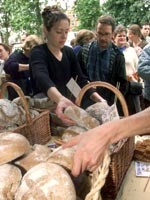
Farmers are also contributing more effectively to government environmental schemes. Direct state ownership of production farms has long since ended but more than 25,000 farmers are now involved in government initiatives and in recent years 400 flourishing farmers’ markets have opened to offer producers scope to sell direct to their customers. Nearly 80,000 farmers and growers are members of farm assurance schemes.

The UK’s leisure and tourist industry, too, is presenting new opportunities for farmers. In the past 20 years an estimated 15,000 farmers have introduced products or services for the leisure market, from big pleasure and educational parks to small-scale facilities for holidaymakers.

Meanwhile the system of state support to food producers is under review with farmers, consumers and the government increasingly anxious to ensure Europe’s Common Agricultural Policy (CAP) develops as an integrated rural development policy.

Reforms to the policy get the support of UK farmers, although the industry is concerned that changes to the proposed phasing-in of farm support to new member states could affect farmers.

Farmers do not see any major competitive threat arising from the introduction of new member states into the European Union (EU), says the National Farmers’ Union. We broadly agree with the proposed EU position on agriculture in the enlargement talks.

Meanwhile another initiative for UK farmers to grasp is new scope for growing green fuels. Research shows almost one fifth of arable land could be devoted to crops for conversion into bio-fuels.

This promises to be one of the most dramatic shifts in the function of farming in recent history, says the National Farmers’ Union. It will provide new opportunities for farmers and will be excellent news for the environment. With such initiatives, UK agriculture is preparing to look ahead to a cleaner, productive and more stable future.

Source : http://www.agriworld.nl/

Promotion olive Cultivation for economic development in poverty alleviation

Promotion olive Cultivation for economic development in poverty alleviation


The plans to plant olive saplings in KP and the rest of Pakistan can bear fruit

By Tahir Ali

With high global demand and rising prices in the international market and Pakistan’s annual edible oil import bill exceeding $2bn, the rationale of recent olive cultivation initiatives in the country cannot be overemphasized. Olive demand globally is on the rise. Germans are using five times more and British ten times more olive than they did in 1990. In America, olive demand is growing by 6pc annually for two decades now. Olive prices in world market have doubled to $3,400 a ton recently. Pakistan has over 0.8mn hectares of wasteland suitable for olive cultivation. An official of the now defunct Pakistan Oil Seeds Development Board (PODB) had told this writer that by covering the area with olive plants, Pakistan can produce around 1.84mn tons of olive oil. This would fetch over $6bn at the current rate of olive in world market.
The Pakistan agricultural research council (PARC) has begun implementing the project “Promotion of olive cultivation for economic development and poverty alleviation” whereby olive plants will be cultivated on 300 hectares in Balochistan, 100 hectares in KP, 300 hectares in federally administered tribal areas and 100 hectares in the Pothohar region of Punjab. The Rs382mn project to be completed in three years is being under the Pakistan Italian debt-for-development swap agreement.
The Punjab Agriculture and Meat Company also plans to develop 10 certified nurseries. These nurseries –being opened through private sector in Attock, Rawalpindi, Chakwal, Jehlum and Khushab districts –would have a catchment area of 27000 acres and would have an impact of $78mn. The potential area suitable for olive cultivation is around 8mn acres in Punjab of which 0.4mn is being targeted though this initiative. Total impact of this land, if covered, would be $1.16bn.

Similarly, in KP’s budget for 2012-13, a Rs100mn project –research and development on European olive and maintenance of model olive farm Sangbhatti Mardan –has been started and allocated Rs15mn this year. As the PODB stands dissolved, Sangbhatti olive farm, one of its assets, has been handed over to the directorate of agriculture research in KP. “The department will provide olive plantlets, grafts and buds produced in the Sangbhatti farm to farmers. Though the production of olive nursery is limited at present, it is nevertheless sufficient for the time being,” says an official of KP agriculture ministry wishing anonymity. “Despite our efforts, mass resort to olive plantation is however unlikely in the immediate future,” the official adds.
Pakistan has been unable to increase its olive acreage and yield for indifference by successive governments, lack of private sector’s interest, focus on other cash crops, security situation in KP and tribal belt, too few olive nurseries and marketing worries. It only has 1130 acres of land under productive olive trees and the crop is yet to be inserted into the cropping system. The question arises: will the new initiatives succeed?

While olive farmers usually grow olive haphazardly, the problem is multiplied by non-availability of standard olive plants and restricted mobility of local and foreign experts in the olive-rich but militancy-hit tribal belt, KP and Balochistan. This explains why there has been of late a shift of focus to other parts of the country. Olive acreage and yield could be increased by providing quality seed, polythene rolls for wrapping round the buds/grafts to save them from cold and moisture, modern training and marketing support to olive farmers. Have similar interventions been planned?
Pakistan has over 0.8mn hectares suitable area for olive but as most farmers on fertile lands prefer other crops, the potential area may be around 0.264mh. Even if a third of this area is brought under olive cultivation, around 25mn olive seedlings would be needed (@250 trees per hectare) over the next few years. Has this been considered? Pakistan need to shift to tissue culture technology, standardise its nursery production and open more germplasm units to provide enough olive seeds, buds and grafts. Olive tree usually bears fruit after 4-5 years. However, Sultan Ali Khan, a farmer from Swat, says his community had grafted around 40000 wild olive trees but only 5000 of them have been successful and have started bearing fruit after 7-8 years. Shafeeq Ahmad from Swari, Buner says an olive plant could bear over 40-45kg of fruit if sufficient care, protection, pesticides and fertilisers are provided to the plants.

“We planted 600 olive plants on a mountain ridge around ten years ago but it is yet to bear plentiful fruit. Bearing of fruit was late and paltry because the orchards could not be looked after well nor were provided sufficient and timely doses of fertiliser and pesticides as the farmers were not given guidance and help,” he tells TNS. Another problem is that very ambitious projects are launched but are later forgotten. For example, there is no mention of the projects of establishment of olive orchards in KP and that of research, development and promotion of olive in KP which were allocated funds in the last two budgets but not in this fiscal and have been left out incomplete. A report on the Malakand olive development prepared by ISCOS, an international organisation, had urged induction of more olive technicians, modern training for them and increase in their salaries, introduction of a system of reward for successful olive farmers, subsidized provision of olive plants, and interaction between all the stakeholders in the olive production chain. The PODB had converted quite a few wild olive plants into fruit bearing trees. That process needs to be continued.

The planners also need to ensure olive production is developed on commercial lines and its enterprises facilitated. Olives are grown by the methods of budding and grafting of wild olive trees or planting of new trees. However, farmers have found the method of grafting most successful. A research showed that around 80-90pc olive trees grown through T-Grafting technique from August to September were successful. The areas with an altitude between 400 and 1,700 meters, slope of 20°, rainfall between 250 mm and 1,000 mm and having a warm, semi arid, winter rain climate are mostly suitable for olive plants. Olive trees can endure low temperature of even -9° C but these can hardly tolerate it at vegetative stage. It however needs a bit low temperatures in winter to be able to produce good amount of inflorescences and flowers in spring. The common diseases in olive plants are trunk decay, sooty mould and peacock spot, which decay and dry up the tree. The olive trees need more nitrogenous fertilizer than phosphorous and potash. The latter two fertilizers should be mixed in the soil before planting of trees at the rate of 200 kg and 300 kg per hectare respectively. Best time of nitrogen fertilizer is pre-flowering and stone-hardening stage.


Reference by: "THE NEWS" (Dated: 07th Sept. 2012)

Green Agriculture—The Next Hot Investment Sector?

Judging by the turnout and interest, green agriculture just might be the next hot investment sector.

Eric Wesoff: March 25, 2010
A surprising number of Silicon Valley investors and bankers gathered in the bucolic confines of the Four Seasons Hotel off of Highway 101 in Palo Alto, California to attend the Agriculture 2.0 Silicon Valley Event. I would hazard to say that the closest many of these folks have gotten to agriculture and soil is the Whole Foods produce aisle or perhaps a vineyard. (I actually had a brief but wildly successful stint as a commercial organic farmer, but that's another story.)

It's a testament to the power of the greentech meme that more than 250 Silicon Valley types came out to learn about sustainable farming, water, GMOs, seeds and biodiversity. In the audience were investors from Mohr Davidow, Greylock, Kleiner Perkins, USVP, Redpoint, Rockport, Khosla Ventures, DFJ, Foundation Capital and many more.

It's possible that VCs can do for agriculture what they've done for online dog food delivery, grocery delivery, and gyroscopic scooters. That is, invest in a field they know nothing about, and totally jam it up.
That being said, and now that I've gotten that last bit of snarkiness out of my system -- there are more than a few venture firms with experience in these specialized fields and a few investment professionals with applicable domain experience. And certainly, many of the investors speaking today have their heart in the right place. It was the first time I heard pro-vegetarian views and tales of yoga practices on a VC panel.
Panelist and Kleiner Perkins partner Amol Deshpande has worked for agriculture giant Cargill, at an indoor tilapia aquaculture firm and co-founded a company exploring germplasm in garlic. He believes that there is an investment opportunity in the agriculture space, but it is "painful and difficult to scale." Since coming to Kleiner Perkins he's been involved in two deals that are "notionally affiliated" with sustainable agriculture -- next generation organic waste management by Harvest Power and APT which is focused on water issues that are largely caused by agriculture. Deshpande describes himself as "very interested in this space."
Certainly the markets are huge. Agriculture accounts for 4 percent of the California economy according to Tom Tomich of UC Davis' Agricultural Sustainability Institute (agriculture also accounts for 8 percent of California energy use, 20 percent of California's land area and more than 40 percent of the state's fresh water use). Tomich also said, "The idea of the dumb farmer is truly a myth -- don't make that mistake," and, "Agricultural innovation responds to market forces."
Despite the size of the market, the big question for investors is: Are VC growth expectations and scaling requirements even feasible in the admittedly huge agricultural markets? Limited partners in VC firms aren't going to lower their expectations in order to invest in farms simply because it's the right thing to do. The hope is just as greentech became mainstream, so can green ag.

According to KP's Deshpande, "At KP we try to be creative, asking how can we change that industry." Along those lines, he mentioned in vitro meat production. (See this article in Beef Magazine and check out the work of Jason Metheny.)
Other investors with a green agriculture focus include Stu Rudick of Mindful Investors. Mindful invests exclusively in the natural, organic and sustainable consumer products and services marketplace. One of their portfolio firms, Organic Girl, sells organic greens and vegetables and had $150 million in sales in their second year of business.
And Jim Schultz of Illinois-based Open Prairie Ventures is also focused on agriculture with offices actually located in the middle of farmlands. One of their portfolio firms, Vestaron, is developing green pesticides based on spider venom.

Issues that can be addressed by green ag investors include water, nitrogen, phosphorous, synthetic fertilizer, local foods, aquaculture, pests, and the move towards organics.
Here is a small crop of examples of green ag companies that presented or exhibited at Agriculture 2.0:
AeroFarm Systems: Calling themselves "The Future of Urban Agriculture," AeroFarm is developing aeroponic technology for growers of "leafy greens" in the $4 billion bag salad market. The design of their farming systems uses no soil, a minimum of fertilizers and water, and can be stacked to maximize space. The company envisions using buildings in NYC to grows salad greens with enormous yields using LED-based lighting. The firm is pre-revenue, has raised $500,000 from The Quercus Trust and 21Ventures and is seeking a $5 million Round A.
Inka Biospheric Systems: Vertical food growing systems and "micro-farms" that support hydroponics -- suitable for urban gardens.
Local Dirt: An early-stage firm that matches producers of locally grown food with buyers.
Marrone Bio Innovations: Environmentally responsible products for weed, plant disease and invasive pest management. Marrone uses naturally occurring microorganisms for Integrated Pest Management -- insecticides, herbicides and products for controlling invasive mussels in waterways.
Open Blue Sea Farms: Open ocean, caged "free-range" fish farmers. Open Blue’s initial species is Cobia, a sashimi-grade, marine white fish, targeted for the gourmet seafood market, the upper 20% of the seafood industry in the U.S.
Pasteuria Bioscience: Nematodes, also known as roundworms, are the most numerous multicellular animals on earth and many of them are parasitic on human agricultural products such as turfgrass and strawberries. Chemical control of nematodes is a multi-billion dollar business and Pasteuria Bioscience has developed a cultivation method for naturally occurring soil bacteria that specifically attack plant-parasitic nematodes.
PurFresh: 20 percent to 40 percent of fresh food is lost to over-ripening or decay. PurFresh has a family of products that spans the food supply chain in pre-harvest, post-harvest, transportation and retail to address this issue. Their transport product "snaps" into marine containers and kills mold, bacteria, viruses as well as eliminates ethylene, which accelerates ripening. The unit also measures atmospheric and physical conditions of the food environment, such as door breach, CO2, and O2, and communicates this information via satellite. The firm has 500 customers and 41 direct employees. They just closed a $10 million Round D. Earlier this month, they made our Top 50 Startups list.
Solum: Solum makes a field-deployable measurement tool that gives immediate answers on soil nutrient needs. Fertilizer amounts to 40 to 50 percent of the operating expense for corn but it is currently applied in an inefficient manner based on average values rather than per-acre needs. Solum allows farmers to apply fertilizer in the right amount, at the right place, at the right time.
Verdant Earth Technologies: Developed at the University of Arizona, Verdant’s system is a controlled-environment high-yield agriculture process that will allow crops to be grown anywhere, with no soil and little water, in shipping-type containers that provide a growing environment for a variety of foods. The system can produce up to many times more food per square foot than conventional farming methods.


About us